Saint Marina in Artemida, Attica - The Local Church, Festival, and Traditions Visitors Discover in Summer
Saint Marina the Great Martyr is the patron saint and spiritual protector of Artemida, a city in Eastern Attica that has developed rapidly over recent decades without losing its deep connection to tradition and faith. For the people of Artemida, Saint Marina is far more than a religious figure or a name in the church calendar. She represents a constant spiritual point of reference, closely connected to family life, children, and the shared memory of the local community.
From Loutsa to Artemida - The Modern Identity of the Town
Until the middle of the 20th century, present-day Artemida was known as Loutsa, a name originating from the Arvanitic dialect and describing a place rich in water and wetlands. For many years, the area functioned mainly as a summer resort of the Mesogeia region, with seasonal visitors and vacation homes.
Over time, Loutsa gradually transformed into a permanent place of residence. In 1974, the official renaming of the town to Artemida expressed the residents’ desire to reconnect with the area’s ancient classical past. At the same time, the Christian character of the town remained unchanged and continues to be expressed through devotion to Saint Marina.
The Life of Saint Marina
Saint Marina was born in 289 AD in Antioch of Pisidia, during a period when Christianity was being harshly persecuted by Roman authorities. Her father, Aidesios, was a pagan priest who raised his daughter according to the pagan beliefs of the era. Her mother, however, died immediately after her birth, an event that decisively shaped the course of Marina’s life.
As a child, Marina was entrusted to a Christian woman in a nearby village, who raised her with faith, simplicity, and prayer. In this environment, Marina became familiar with Christian teachings and developed a strong spiritual foundation from an early age.
At just twelve years old, Marina was baptized and consciously dedicated her life to Christ. Her faith was not a childhood impulse, but a deep, steady, and deliberate choice.

Confession of Faith and Complete Rejection
When Marina revealed her Christian faith to her father at the age of fifteen, his reaction was severe. Enraged, he publicly disowned her, cutting all ties. Despite the emotional pain and complete isolation that followed, Saint Marina did not retreat or compromise. Instead, she chose the path of open confession, fully aware of the dangers ahead.
Arrest and Brutal Torture
Marina’s arrest was ordered by Governor Olybrius, who was struck by her beauty, modesty, and inner strength. At first, he attempted to persuade her to renounce her faith through flattery, promises, and even the offer of marriage.
Her refusal led to a series of brutal tortures. She was suspended, her body torn with iron claws, and burned with lit torches. Despite the unbearable pain, Saint Marina remained unshaken, transforming her suffering into a powerful testimony of faith.
Saint Marina and the Defeat of Evil
One of the most striking elements of Saint Marina’s life is her confrontation with the devil while imprisoned. According to tradition, the devil appeared before her in the form of a terrifying dragon and attempted to devour her. Marina prayed, and the dragon was destroyed.
The devil then reappeared in the form of a dark human figure, whom Marina struck and defeated. This episode explains why Saint Marina is often depicted in iconography standing over a dragon and why she is believed to protect against evil and illness, especially illnesses affecting children.
Martyrdom and Holy Relics
Saint Marina’s martyrdom ultimately ended with beheading. Before this, according to tradition, she was miraculously saved from an attempt to drown her in a water tank. At that moment, a dove appeared holding a crown above her head, symbolizing her spiritual victory.
Her relics were preserved in Constantinople until the first sack of the city in 1204. Today, the holy hand of Saint Marina is kept at the Vatopedi Monastery on Mount Athos, while fragments of her relics are often transferred to churches for veneration, particularly during her feast on July 17.
Saint Marina as the Patron Saint of Artemida
The town of Artemida takes its name from the ancient goddess Artemis, as important remains of the Sanctuary of Artemis Tauropolos can be found in the area of Vravrona and along the central coastline.
In Christian times, however, the spiritual protection of the town became firmly associated with Saint Marina. Her name comes from the Latin marinus, meaning “of the sea,” a fitting connection for a seaside town. At the same time, in local folk tradition, her name is associated with the Greek verb maraino (“to wither”), reinforcing the belief that Saint Marina heals and protects.
The Church of Saint Marina in the Heart of the Town
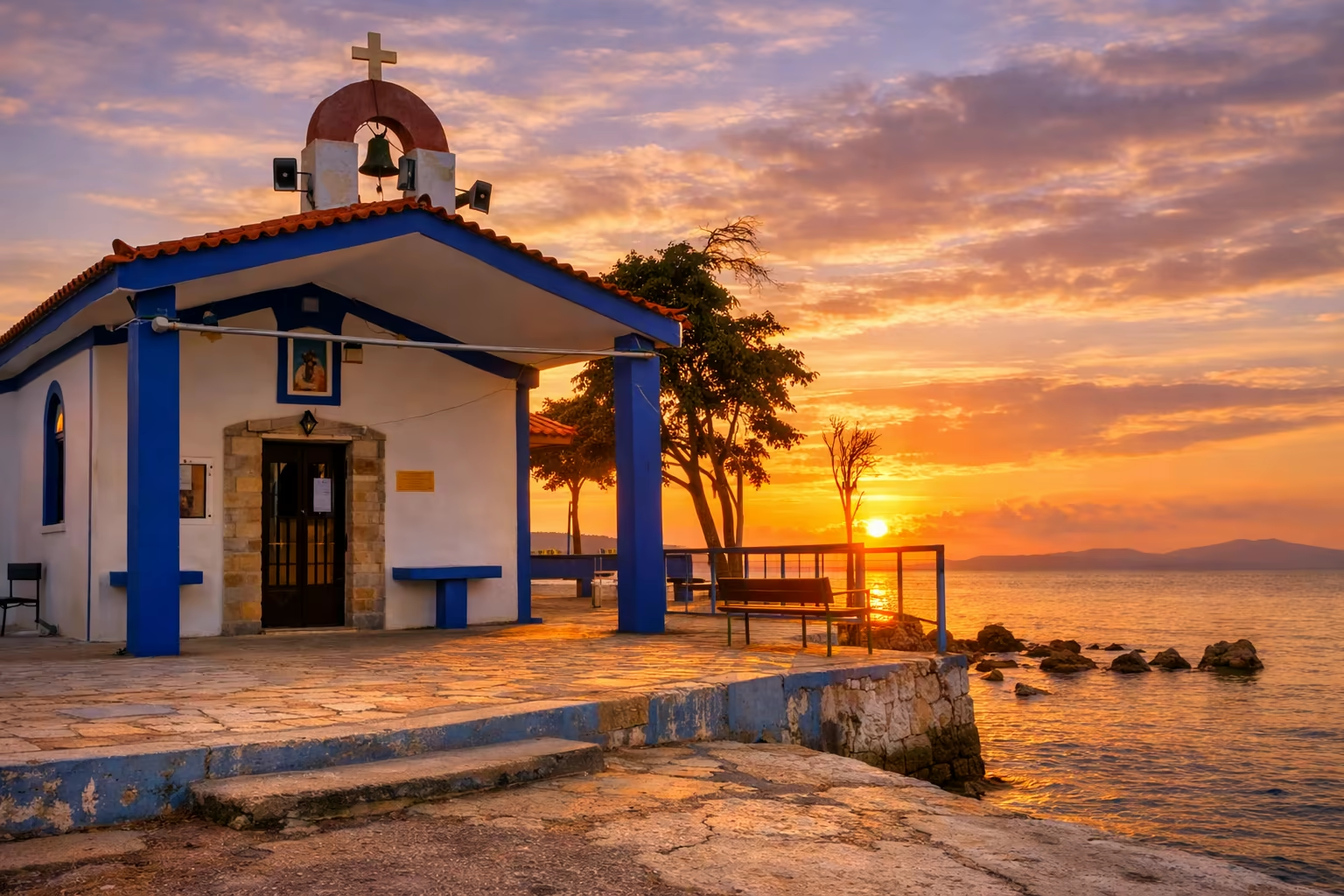
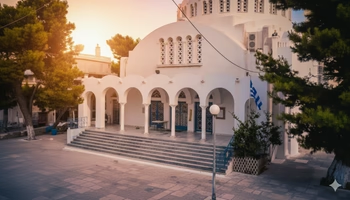
The Parish Church of Saint Marina stands in a central location in Artemida, at the intersection of Themistokleous and Hydras streets, just a short distance from the beach. It serves as the town’s main spiritual landmark and belongs administratively to the Metropolis of Mesogaia and Lavreotiki, which was also established in 1974.

The church maintains a full liturgical program, including daily morning and evening services, frequent all-night vigils, catechism programs for children and adults, charitable activities, and pilgrimages to religious destinations such as Thessaloniki and the Monastery of Kleiston.
Celebrating Saint Marina on July 16 and 17
The feast of Saint Marina is the most important religious event in Artemida. Celebrations begin on July 16 in the evening with the Great Festal Vespers, usually around 7:30 PM, with the participation of many clergy from the Metropolis and the blessing of bread.
This is followed by the procession of Saint Marina’s icon, which begins around 8:30-9:00 PM and passes through the main streets of the town. The procession is accompanied by the municipal philharmonic band, ceremonial guards, and local authorities, while residents line the streets, laying carpets and scattering flowers.
On July 17, the feast day itself, Orthros and the Festal Divine Liturgy begin at 7:00 AM, often presided over by the Metropolitan. In the afternoon, a closing vespers service and supplication to Saint Marina bring the liturgical celebration to an end.

The Fair, Cultural Events, and Local Tradition
Alongside the religious celebrations, the feast is accompanied by a large open-air fair, one of the biggest in Attica, significantly boosting the local economy and attracting visitors from across the region. The Municipality of Spata - Artemida includes the celebration in its “Cultural Summer” program, offering concerts, traditional dance performances, and activities for children.
In local folklore, Saint Marina marks a turning point of summer. Older generations used to say that “Saint Marina softens the heat,” preparing nature for the upcoming grape harvest and connecting the feast to the agricultural cycle of the Mesogeia region.